Chapter 1: Matter in Our Surroundings
Particles Have Space Between Them
Characteristics of Particles of Matter
1️⃣ Particles Have Space Between Them
From Activities 1.1 and 1.2, we observed that particles of:
- Sugar
- Salt
- Dettol
- Potassium permanganate
...got evenly distributed in water.
Everyday Examples
When we make:
- ☕ Tea
- ☕ Coffee
- 🍋 Lemonade (Nimbu Paani)
Particles of one substance get into the spaces between particles of another.
This proves there is enough space between particles of matter!
2️⃣ Particles Are Continuously Moving
🧪 Activity 1.3: Incense Stick Experiment
| Condition | Observation |
|---|---|
| Unlit stick | Need to go very close to smell it |
| Lit stick | Can smell it from a distance! |
Why? The heated particles move faster and spread throughout the room.
🧪 Activity 1.4: Ink in Water (Diffusion)
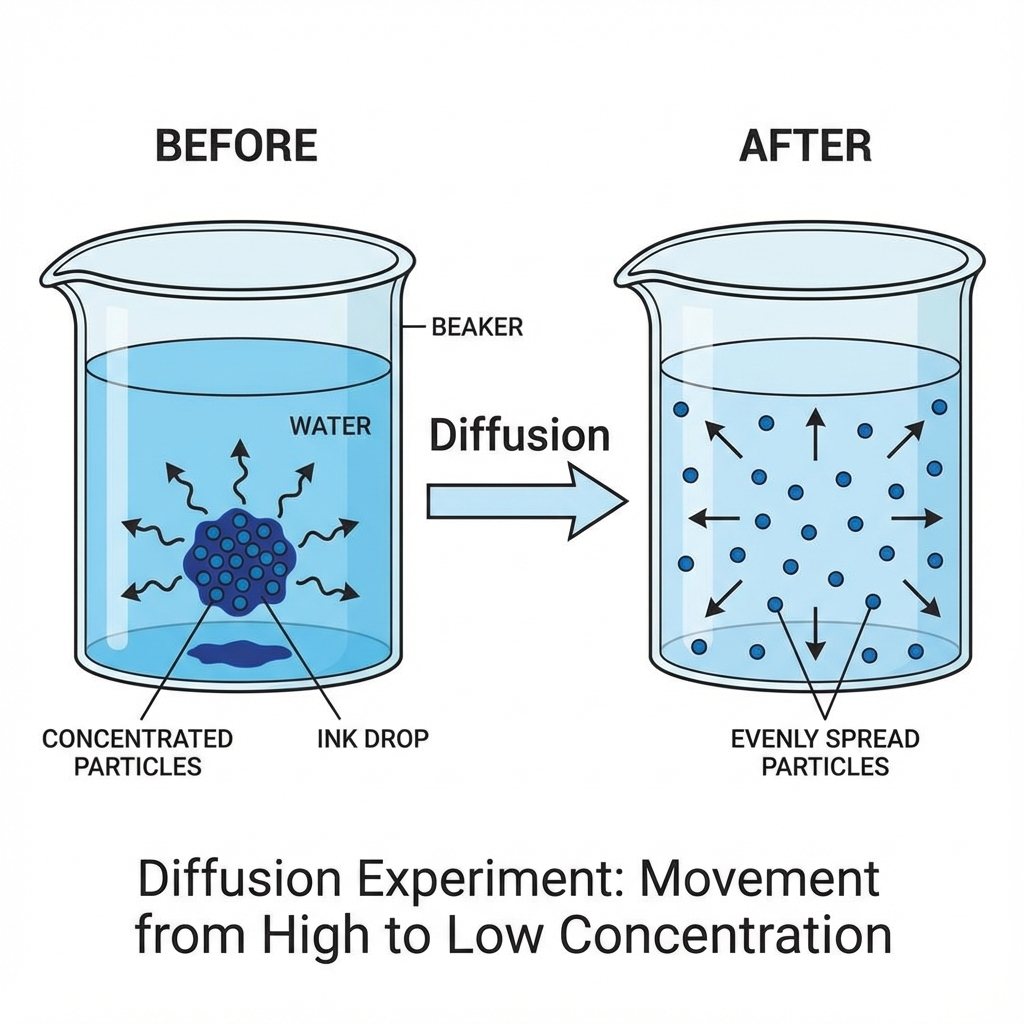
Procedure: Drop ink slowly into a beaker of water (don't stir)
Observation:
- Immediately: Ink stays concentrated
- After hours/days: Colour spreads evenly
Key Concept: Diffusion 🌀
Diffusion is the intermixing of particles of two different types of matter on their own.
Important: Diffusion becomes faster with higher temperature because particles move faster!